
One-Tap Generation and Per-Story Payment — From Subscription to Single Payment
 Jerome Na
Storybooks Are Not Made Monthly
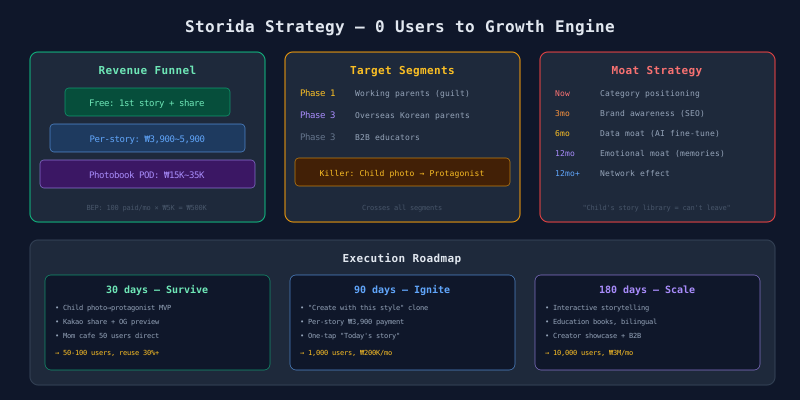
Monthly subscription models have a premise: users return every month. AI storybook generation does not fit this premise. Storybooks are made for birthdays, anniversaries, special moments — 2-3 times per year.
The transition: subscription to per-story payment. Simultaneously, a one-tap mode was designed to lower the creation barrier.
One-Tap “Today’s Story” — Start with a Name
The existing creation flow had many settings. Style, prompt, characters, scene count, character count. UX simplification reduced these to 3 essentials, but an even more extreme path was needed: a mode where entering a name is all it takes.
The one-tap mode design principle: what the user does not decide, the server decides.
User input: child's name (1 field)
Server decides:
  - Situation → random selection from template pool
  - Writing style → random selection
  - Art style → random selection
  - Scene count: 3 (fixed)
  - Chars per scene: 150 (fixed)
Situation templates are stored as a JSON array in the system settings table. Admins can add and modify them without code deployment. Templates contain `` placeholders. The server substitutes them and passes the result to the existing generation pipeline unchanged.
Frontend changes are minimal. One mode parameter is added to the existing generation API. When mode: 'quick', the server fills the rest. The client sends only the name.
Creation page top section:
┌─────────────────────────────────────┐
│ "Tell your child a story tonight"   │
│                                     │
│ [Child's name]  [Today's story ▶]  │
│                                     │
│ ↓ Scroll down for detailed settings │
└─────────────────────────────────────┘
Detailed settings remain intact. One-tap mode is an entry point, not a replacement of existing features.
Per-Story Payment — Single Confirmation, Not Billing Key
The existing subscription payment uses billing keys. A card is registered, and charges occur automatically each month. Per-story payment is different: the user approves each payment. It is one-time.
With TossPayments, the difference between the two approaches is clear.
| Item | Subscription (Billing Key) | Per-Story (Single Payment) |
|---|---|---|
| Card registration | Required (authKey → billingKey) | Not required |
| Payment approval | Server automatic (billingKey) | User explicit |
| API | Billing key issue + billing key charge | confirm (paymentKey + orderId) |
| Recurrence | Monthly automatic | Each time manual |
The existing Toss API call logic from subscription payment was extracted into a shared utility. Billing key issuance, billing key payment, single confirmation, and payment cancellation are unified in one client class. Both subscription service and token purchase service share the same client.
Token Package Design
The per-story payment unit is a “token package.” A product table stores prices and token amounts set by admins.
Example product configuration:
| Package | Tokens | Price | Meaning |
|---|---|---|---|
| 1 story | 750 | ₩3,900 | Base unit |
| 3 stories | 2,250 | ₩9,900 | Bundle discount |
| 10 stories | 7,500 | ₩29,900 | Volume discount |
The product list is served via a public API. No authentication required — unauthenticated users should be able to check pricing first.
Payment Flow
Payment splits into 3 stages.
Stage 1 — Checkout: The user selects a product, and the server creates an order. The server returns an order ID, amount, and payment client key.
Stage 2 — Payment Widget: The Toss payment widget appears. The user enters card information and approves payment. On success, a paymentKey is returned.
Stage 3 — Confirm: The client sends the paymentKey to the server. The server calls the Toss confirmation API. On success, tokens are credited immediately.
User → select package → POST checkout → receive orderId
     → Toss widget payment → receive paymentKey
     → POST confirm → tokens credited
The existing token system’s addon_tokens field is reused. Token history records with source: 'addon_purchase'. Since it is managed separately from subscription tokens, the deduction order follows existing logic (add-on first → subscription tokens).
Code Reuse Strategy
A new feature, but no new patterns.
- Payment: Toss client extracted as shared utility. Subscription and per-story both use it.
- Tokens:
addon_tokensandtoken_historyused as-is. Only one new table: the product list. - Generation:
modeparameter added. Rest of the pipeline unchanged. - Payment widget: Toss SDK already used for subscription payment, reused here.
The principle: add features following existing patterns, no architecture changes.
Conclusion
Storybook creation frequency does not match subscription models. Per-story payment aligns with user behavior patterns. One-tap mode eliminates “settings fatigue.” Combined, the entry barrier reaches its minimum. Enter name → pay → storybook complete. Three steps.