
DB-Based Job Queue — Async Generation System to Bypass Vercel Timeouts
 Jerome Na
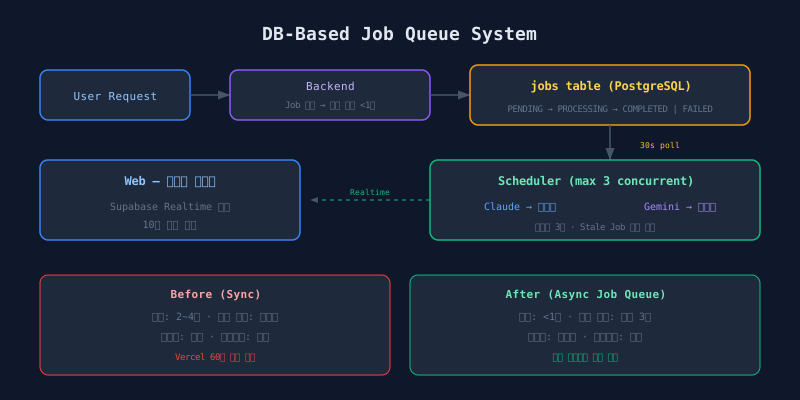
The Problem: 2-4 Minutes of AI Generation
Claude writes text. 30 seconds to 1 minute. Gemini draws images. 20-30 seconds per scene, 2 minutes for 5 scenes. Total: 2-4 minutes per book.
Three problems followed.
- Vercel 60-second limit: Web and Backend deploy on Vercel/Railway. API timeout is 60 seconds.
- No concurrency control: Burst requests flood AI API calls. Server overload.
- No user feedback: Users stare at a blank screen for 2-4 minutes.
The old system had Backend call AI directly and hold the response until completion. We switched to a DB-based job queue.
Architecture Decision
Options Considered
| Option | Pros | Cons |
|---|---|---|
| Scheduler calls AI directly | Best performance, independence, scalability | Possible code duplication |
| Scheduler calls Backend HTTP then AI | Code reuse | Network latency, Backend load |
| Scheduler imports Backend functions | Single codebase | Requires monorepo restructuring |
Scheduler calls AI APIs directly. Routing through Backend adds an unnecessary network hop. Backend failure blocks generation. Direct AI calls from Scheduler keep generation independent of Backend health.
Job Queue Design
Jobs Table
Each job record tracks its type (e.g., book generation or image regeneration), current status, the owning user, the target book, and retry metadata (attempt count, max attempts). A JSONB payload field carries all data the Scheduler needs for generation, eliminating additional DB lookups. Error messages and timestamps round out the record for observability.
Status Flow
PENDING ──────> PROCESSING ──────> COMPLETED
                    |
                    | error
                    v
              attempts < 3?
              |-- Yes -> PENDING (retry)
              +-- No  -> FAILED
Index Design
A composite index on job type and status is the critical one — the Scheduler’s main query filters by type and status together. Additional indexes on user and book references support lookup and join operations.
Backend: Respond Immediately
// POST /api/generate
// 1. Validate tokens and pre-deduct the expected cost
// 2. Create an empty book record with PENDING status
// 3. Register a job with the generation payload
// 4. Respond immediately (<1s) with book ID, job ID, and status
The user gets a response within 1 second and returns to the main screen. Generation runs in the background.
Token pre-deduction happens at request time. This prevents double-spending during the 2-4 minute generation window. If generation fails, the system refunds tokens.
Scheduler: Job Processing Loop
// Every 30 seconds:
// 1. Query up to 3 oldest PENDING book-generation jobs
// 2. Process all fetched jobs in parallel
//    (each job runs independently — one failure does not affect others)
Concurrency caps at 3. This number balances AI API rate limits and server resources. Promise.allSettled ensures one job failure does not affect others.
AI Generation Pipeline
// AI Generation Pipeline:
// 1. Prepare generation context from the job payload
// 2. Generate full text via Claude, update progress to WRITING
// 3. Parse the text into pages and save them
// 4. For each page sequentially:
//    - Generate an image via Gemini and upload it
//    - Update progress (IMAGES: page N of total)
// 5. Mark the book as completed
Image generation runs sequentially per page. Parallel calls trigger frequent 429 errors from Gemini. Sequential processing with per-page progress updates is the trade-off.
Real-Time Progress: Supabase Realtime
The Web client subscribes to contents table changes via Supabase Realtime.
The Web client opens a Supabase Realtime channel that listens for row-level changes on the contents table, filtered to the current user. When the Scheduler updates a book’s generation progress, the client receives the new progress value in real time and updates the UI.
Polling Fallback
WebSocket connections drop. Missed events leave the UI stale. A 10-second polling interval runs as insurance. It activates only when books are generating.
When any book is in a generating state, a 10-second polling interval activates as a fallback. Once no books are generating, the polling stops automatically. This ensures the UI stays current even if the WebSocket connection drops.
Stale Job Recovery
When the Scheduler restarts, PROCESSING jobs become orphaned. The system auto-recovers stale jobs on startup.
// On Scheduler startup:
// Find all jobs stuck in PROCESSING for over 30 minutes
// Reset their status back to PENDING for the next polling cycle to pick up
Any job stuck in PROCESSING for over 30 minutes resets to PENDING. The next polling cycle picks it up. Combined with max 3 attempts, this ensures no job is permanently lost.
Performance Comparison
| Metric | Before (Synchronous) | After (Async Job Queue) |
|---|---|---|
| Request to response | 2-4 min | < 1 second |
| Concurrency | Unlimited (overload risk) | Max 3 (controlled) |
| User feedback | None | Real-time progress |
| Server failure impact | Entire generation fails | Auto-retry recovers |
| API timeout | Possible | Impossible |
Why Not Redis or RabbitMQ
An external message queue adds infrastructure management overhead. At tens to hundreds of jobs per day, PostgreSQL’s SELECT ... ORDER BY created_at LIMIT 3 is sufficient. If traffic grows 10x, we introduce a dedicated queue then.
The database is already there. The polling interval is 30 seconds. The concurrency cap is 3. For this scale, a separate queue service is unnecessary complexity.
Next: the multi-character system and Claude Vision image analysis.