
Cloudflare R2 Migration and Scheduler Modularization
 Jerome Na
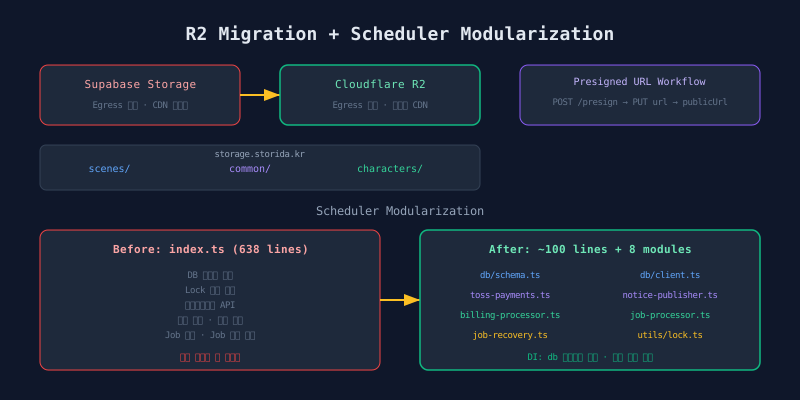
Two changes shipped on the same day. R2 migration for storage costs. Scheduler modularization to make the migration manageable. They reinforced each other.
Part 1: Supabase Storage to Cloudflare R2
Why Migrate
Supabase Storage worked for early development. Growth exposed the cost structure.
| Criteria | Supabase Storage | Cloudflare R2 |
|---|---|---|
| Cost | Free tier limited, then steep | 10GB free, then $0.015/GB |
| Egress cost | Charged | Free |
| CDN | Supabase CDN | Cloudflare global CDN built-in |
| Custom domain | Limited | Full control |
| Presigned URL | Not supported | S3-compatible API, full support |
Egress cost was the deciding factor. A storybook service serves images repeatedly. Every page has an illustration. Users revisit their books. R2 charges zero egress. The savings compound with every new user.
R2 Setup
| Environment | Bucket | Public URL |
|---|---|---|
| Development | myapp-dev |
cdn-dev.example.com |
| Production | myapp |
cdn.example.com |
Custom domains via Cloudflare DNS. No CORS headaches — same-origin requests through the custom domain.
Directory Mapping
Directory structure mirrors the old Supabase buckets. This minimized migration complexity.
| Old Supabase Bucket | R2 Directory | Purpose |
|---|---|---|
media |
media/ |
Scene images, PDFs, previews |
shared |
shared/ |
Fonts, notice images |
| (new) | assets/ |
Character images |
Presigned URL Workflow
The old system had clients upload via the Supabase SDK. R2 uses presigned URLs instead.
Client -> POST /api/upload/presign
          { bucket: "assets",
            path: "abc.jpg",
            contentType: "image/jpeg" }
       <- { uploadUrl: "https://...(signed URL)",
            publicUrl: "https://cdn.example.com/assets/abc.jpg" }

Client -> PUT uploadUrl (file binary)

Client -> Access via publicUrl
Three advantages:
- Backend never touches file bytes: Bandwidth saved.
- Auth check at presign time: Backend verifies the user before issuing the signed URL.
- No client SDK required: Standard HTTP PUT handles the upload.
Legacy URL Compatibility
Existing DB rows contain Supabase Storage URLs. Bulk replacement is risky. Gradual transition instead.
- Existing Supabase URLs: Keep working. Supabase Storage stays public.
- New uploads: Store R2 URLs.
- Delete operations: Only delete R2 URLs. Supabase URLs get a warning log.
Over time, R2 URL ratio increases naturally. Once coverage is sufficient, Supabase Storage gets decommissioned.
Code Changes
| App | Change |
|---|---|
| Backend | supabase-storage.ts replaced by r2-storage.ts (same interface) |
| Scheduler | Supabase SDK removed, uploadToR2() function added |
| Admin | Direct Supabase upload replaced with presigned URL flow |
| Web | PDF generation uses presigned URLs |
r2-storage.ts maintains identical function signatures to supabase-storage.ts. uploadImage, downloadImage, deleteFile — change the import path and everything works.
Part 2: Scheduler Modularization
Problem: 638 Lines in One File
During R2 migration, the Scheduler’s src/index.ts revealed its true size: 638 lines. DB schema definitions, lock management, Toss Payments API calls, automated billing, notice publishing, stale job recovery, job processing — all in one file.
Finding the storage code to replace meant scrolling through billing logic and lock management. The file needed splitting before any safe modification.
Before
scheduler/src/
+-- constants.ts
+-- index.ts              # 638 lines -- everything
+-- services/
    +-- generation.service.ts
After
scheduler/src/
+-- constants.ts
+-- index.ts              # ~100 lines -- orchestrator only
+-- db/
|   +-- schema.ts         # Table definitions
|   +-- client.ts         # DB connection factory
+-- utils/
|   +-- lock.ts           # Lock file management
+-- services/
    +-- payment-gateway.ts    # Payment API utilities
    +-- publisher.service.ts  # Scheduled publishing
    +-- billing.service.ts    # Automated billing
    +-- job-recovery.ts       # Stale job recovery
    +-- job.service.ts        # Job processing loop
    +-- generation.service.ts # AI generation pipeline
Eight module files. Each has a single responsibility. Each is testable in isolation.
DB Client Factory Pattern
Module-scope variables create hidden dependencies. The factory pattern makes them explicit.
A factory function creates the DB client from a connection URL. The entry point creates one client instance and passes it into every service function as the first parameter. This is dependency injection at the function level — easy to mock for tests, no global state.
Toss API Signature Change
Module-scope closure captured TOSS_SECRET_KEY implicitly. Explicit parameters replaced it.
Previously, functions captured secrets via module-scope closures (implicit dependency). After refactoring, every external dependency — including API keys — is passed as an explicit function parameter. Every dependency is visible in the function signature. No hidden state.
index.ts: Orchestrator Only
After refactoring, index.ts does five things:
index.ts responsibilities:
1. Validate environment variables (DATABASE_URL required)
2. Acquire lock (prevent duplicate execution)
3. Register signal handlers (SIGTERM, SIGINT)
4. Create DB client
5. Register 3 timers:
   - 30s: Job processing
   - 60s: Notice publishing + job recovery
   - 1h:  Automated billing
No business logic. No API calls. No DB queries. Pure orchestration.
Zero Behavior Change
Logic stayed identical. Only file locations changed. tsup bundles everything into a single output. Deployment is unaffected.
Build verification:
yarn build:scheduler  # compiles without error
# Deploy as usual
No new dependencies. No new APIs. No changed behavior. The refactor is invisible to users and downstream systems.
Why Both on the Same Day
The R2 migration required changing storage code inside the Scheduler. The 638-line monolith made that change risky. Split first, then swap.
Refactoring gets postponed indefinitely if separated from feature work. Doing it when the pain is fresh — when you’re staring at the 638-line file trying to find the upload function — that’s the right time. The migration provided the motivation. The modularization provided the safety.
Next: content type expansion design.